
Illinois SOS Permit Practice Test 23
- Questions35
- Correct to pass28
- Passing score80%
- Minimum age15 years
-
1. In plain words, what is oversteer?
Show answer
Answer C: The rear of the vehicle slides out and the car turns too sharply
Oversteer means the rear tires have lost grip first, so the tail swings out and the vehicle turns more than you asked it to.
-
2. What cellphone rule applies to Illinois drivers under age 19?
Show answer
Answer B: All wireless and cellphone use is prohibited, including hands-free devices, except to contact emergency services
Illinois prohibits any wireless or cellphone use by a driver under 19, including hands-free devices, except in an emergency to reach law enforcement, a health care provider or an emergency services agency.
-
3. Which of these would appear as a symbol on a blue general service sign?
Show answer
Answer A: A hospital
General service signs cover facilities such as hospitals, fuel, food, lodging, camping, telephones and rest areas, all shown in white on blue.
-
4. The motorcyclist ahead of you keeps moving from one side of the lane to the other. What should you understand?
Show answer
Answer B: The rider is avoiding surface hazards and staying where drivers can see the bike
Riders shift their lane position to avoid debris, grease strips and potholes and to be seen. That movement is normal and never an invitation to share the lane.
-
5. How should a head restraint be adjusted?
Show answer
Answer D: So the top is at least as high as the back of your head and close behind it
A restraint set at head height and close behind limits how far the head snaps backward in a rear impact, which is what reduces neck injury.
-
6. You realize at the last moment that you have passed the street where you meant to turn. What should you do?
Show answer
Answer D: Keep going and turn around where it is safe and legal
A missed turn is a minor inconvenience; braking suddenly, backing up or turning across traffic to recover it causes crashes.
-
7. How can you tell that a child safety seat is installed tightly enough?
Show answer
Answer C: It moves less than an inch side to side or front to back at the belt path
A correctly installed seat is nearly immovable where the belt or lower anchors pass through it. Excess movement lets the child's body travel farther in a crash.
-
8. How can you check that you are keeping a safe following distance?
Show answer
Answer A: Count at least three seconds between the vehicle ahead passing a fixed object and your reaching it
Pick a fixed roadside object, start counting when the vehicle ahead passes it and make sure at least three seconds elapse before you reach it, adding more time in poor conditions.
-
9. Your green left-turn arrow goes out and a steady green ball stays lit. What may you do?
Show answer
Answer A: Continue turning left, but only after yielding to oncoming traffic
When the arrow ends and a green ball remains, the turn changes from protected to permissive, so it is still allowed but oncoming traffic goes first.
-
10. You are approaching the entry of a roundabout and a pedestrian is crossing the marked crosswalk on your approach lane. What must you do?
Show answer
Answer D: Stop before the crosswalk and let the pedestrian cross
Roundabout crosswalks sit a short distance back from the yield line, and drivers must yield there before they ever reach the circulating lanes.
-
11. Where is passing prohibited even when no line is visible?
Show answer
Answer D: On a curve or near the crest of a hill, at intersections and at railroad crossings
Passing is prohibited wherever your view of oncoming traffic is blocked or where vehicles may cross your path, which includes hills, curves, intersections and rail crossings.
-
12. A front tire blows out at highway speed. What should you do?
Show answer
Answer B: Hold the wheel firmly, ease off the accelerator and slow gradually before leaving the road
A blowout pulls the vehicle toward the failed tire, and hard braking or sharp steering can turn that pull into a spin, so a firm grip and gradual slowing keep the vehicle straight.
-
13. On an unlit road, about how far ahead do high beams normally let you see?
Show answer
Answer D: About 350 to 500 feet ahead of the vehicle
High beams light roughly 350 to 500 feet of road and low beams far less, which is why night speeds have to be chosen around the beam, not the limit.
-
14. How do strong emotions affect driving?
Show answer
Answer B: They narrow your attention and make risky decisions more likely
Anger, worry and excitement all take attention away from the driving task and push drivers toward decisions they would not normally make.
-
15. At roughly what speed can hydroplaning begin when a lot of water is lying on the road?
Show answer
Answer C: At speeds as low as about 35 mph
With enough water and less than perfect tread, a tire can start to ride on the water at around 35 mph, well below normal highway speeds.
-
16. A flashing red arrow is displayed for your turning lane. What does it require?
Show answer
Answer D: Stopping, then turning when the way is clear
A flashing red arrow is treated like a stop sign for that movement: come to a full stop, then turn when it is safe and no one has to be cut off.
-
17. A freeway sign reads BUSES ONLY ON SHOULDER 6 AM TO 9 AM. Who may drive on the shoulder then?
Show answer
Answer A: Only the vehicles named on the sign, during the hours shown
Shoulder running is granted by the sign to the class of vehicle and the hours the sign names, and it does not turn the shoulder into a general travel lane.
-
18. A hot drink tips over onto your lap while you are driving. What should you do?
Show answer
Answer A: Keep hold of the wheel and stop when it is safe
The spill is painful but the crash risk comes from letting go of the wheel or braking suddenly, so keep control and deal with it once you are stopped.
-
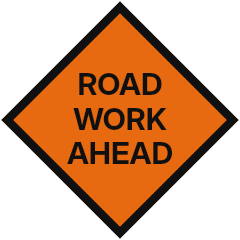
19. This sign is still standing late at night, and nobody is working. What should the driver assume?
Show answer
Answer B: The layout may still be altered, so the same care and reduced speed apply
Narrowed lanes, shifted alignments, dropped pavement edges and parked equipment remain overnight, so the hazard does not end when the crew goes home.
-
20. You are driving in the left lane at the posted speed limit and a line of vehicles has built up behind you. What should you do?
Show answer
Answer D: Move into a lane on your right when it is safe and let the traffic behind go by
Most states require traffic moving slower than the flow to keep right and reserve the left lane for passing, so a driver holding up a line of vehicles should move right when it is safe rather than block the lane.
-
21. A set of reversible express lanes is closed off with gates and signs while it runs the other way. What must you never do?
Show answer
Answer C: Enter past a closed gate or a sign showing the lanes are closed
When reversible lanes are closed they may already be carrying traffic in the opposite direction, so entering past a gate can put you head-on into that traffic.
-
22. The signal turns green as you approach an intersection. What is the safest practice?
Show answer
Answer B: Look left, then right, then left again, and make sure the intersection is clear before entering
A green light gives permission but does not guarantee the intersection is empty, and a quick scan catches a vehicle running the red or a pedestrian still crossing.
-
23. What counts as a complete stop at a stop sign?
Show answer
Answer C: The wheels stop turning before the stop line
A legal stop means the vehicle is no longer moving, made at the stop line or before entering the crosswalk or intersection.
-
24. When an Illinois insurer settles a total loss auto claim, what is the maximum betterment deduction it may take for wear, tear, missing parts, and rust?
Show answer
Answer D: $500
Illinois caps the betterment deduction an insurer may take for wear and tear, missing parts, and rust in a total loss settlement at $500.
-
25. How much clear road do driver manuals say you need before starting a pass at highway speed on a two-lane road?
Show answer
Answer C: Enough to complete the pass and return, roughly ten to twelve seconds of travel
At highway speed the whole maneuver of pulling out, overtaking and returning takes roughly ten to twelve seconds, and every foot of that has to be visible before you start.
-
26. You realize you have driven several miles without remembering any of it. What kind of distraction is this?
Show answer
Answer C: Cognitive distraction, because your mind was not on driving
Daydreaming or being lost in thought is a cognitive distraction. Your eyes may be on the road, but your brain is not processing what they see.
-
27. A train has just passed a crossing that carries more than one set of tracks. What should you do?
Show answer
Answer B: Wait until the warning devices stop and you can see clearly along every track
A passing train can hide a second one coming on another track, so wait for the signals to clear and check each track before moving.
-
28. Under Illinois' Dram Shop Act, who can be held liable if a person who was unlawfully sold alcohol as a minor or as an already-intoxicated person then causes a crash?
Show answer
Answer B: The establishment or person who unlawfully sold or served the alcohol
Illinois' Dram Shop Act can hold the establishment or individual who unlawfully sold or served alcohol to a minor or an intoxicated person liable for resulting injuries.
-
29. A yellow diamond shows a car with wavy lines behind its rear tires. What is the warning?
Show answer
Answer D: The surface loses grip badly when it is wet
The slippery when wet sign marks a stretch where traction falls off sharply in rain, so speed and braking must be reduced well in advance.
-
30. You are turning left from a one-way street onto a two-way street. How should the turn be made?
Show answer
Answer B: Start in the far left lane and finish just to the right of the center line
Left turns begin from the lane nearest the left edge of the street you are leaving and must finish on the right-hand side of the center line of a two-way street.
-
31. A sign with a blue background and a white legend and border tells road users about
Show answer
Answer A: services such as fuel, food, lodging, hospitals and rest areas
Blue is the background of the general service series, which points travelers toward the services available along or near the route.
-
32. You are in the middle lane of a one-way street with three lanes when a police car approaches from behind with lights and siren. What should you do?
Show answer
Answer C: Pull to the nearest curb and stop clear of the lanes
On a one-way street you clear to whichever curb is closest, so the emergency vehicle gets a clear path down the open lanes.
-
33. What is the best way to keep your phone from distracting you on a trip?
Show answer
Answer D: Silence it and stow it before you start
A phone you cannot hear and cannot reach cannot tempt you, which is far more reliable than deciding case by case while you drive.
-
34. On a two-way street, where and how should you park at the curb?
Show answer
Answer C: On the right side, facing the way traffic moves
On a two-way street you must park on the right, headed in the direction of travel; parking facing traffic is prohibited.
-
35. What monthly monitoring fee does an Illinois BAIID participant pay to the Secretary of State's office?
Show answer
Answer D: $30
A participant in Illinois' BAIID program pays a non-refundable monthly monitoring fee of $30 to the Secretary of State's office.