
Illinois SOS Permit Practice Test 33
- Questions35
- Correct to pass28
- Passing score80%
- Minimum age15 years
-
1. Your vehicle has stalled on railroad tracks and no train is in sight. After getting everyone away, whom should you call first?
Show answer
Answer B: The railroad emergency number posted on the blue sign at the crossing, giving the crossing number
Every public crossing has a blue emergency notification sign with a phone number and a crossing identification number. That call lets the railroad stop or slow trains before they reach you.
-
2. You are parking facing uphill on a street with a curb. What is the correct wheel position?
Show answer
Answer B: Turn the front wheels away from the curb and let the vehicle roll back until a tire touches it
Facing uphill the vehicle would roll backward, so the wheels point away from the curb and the tire is rested against it to act as a block.
-
3. An angry driver is following you closely and gesturing at you. What is the safe response?
Show answer
Answer B: Drive to a police station or to a busy public place and call for help
Never stop to confront an aggressive driver and never lead one home; go somewhere public and get the police involved.
-
4. A driver slows to walking pace at this sign, never stops rolling and eases into the intersection. How is that treated?

Show answer
Answer B: It is a violation, because the vehicle never came to a complete halt
What is required is a full halt with the wheels no longer turning, so slowing down, however carefully, does not satisfy it.
-
5. Your steering suddenly feels light and unresponsive as you drive through standing water. What should you do first?
Show answer
Answer A: Ease off the accelerator and keep the steering wheel pointed straight
Those symptoms mean the tires are riding on a film of water, and gently lifting off the accelerator lets them settle back onto the pavement. Hard braking or sudden steering while hydroplaning can start a skid.
-
6. You leave a brightly lit service area onto a dark rural road. Why should you slow down for a while?
Show answer
Answer C: Your eyes need time to adjust, so at first you see less
Eyes take a few minutes to adapt from bright light to darkness, and during that time you can see much less than your headlights actually show.
-
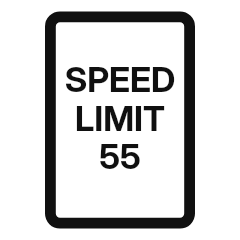
7. A driver passes this sign on an open road. Over what stretch does the figure it sets stay in force?
Show answer
Answer A: From the sign onward, in every lane, until another sign sets a different figure
The figure governs the road from the sign onward and binds every lane, and it stays in force until a later sign sets a different one.
-
8. You signaled a lane change and the signal did not switch itself off afterwards. Why does that matter?
Show answer
Answer B: Other drivers may act on a turn you do not intend to make
A signal left on tells other drivers you are about to turn, and someone may pull out in front of you. Cancel it as soon as the maneuver is finished.
-
9. You feel fine twenty minutes after your last drink. Why is that a poor guide to driving?
Show answer
Answer B: Your blood alcohol level can still be rising
Alcohol keeps being absorbed for some time after the last drink, so a driver who feels able at the door can be more impaired a few miles down the road.
-
10. Heavy trucks have worn deep ruts into a highway lane and rain has filled them. What is the danger?
Show answer
Answer D: Water collects in them, so the tires can lose contact with the road
Ruts hold standing water long after the rest of the lane has drained, which makes them the most likely place to start hydroplaning.
-
11. What offense does an Illinois vehicle owner commit by knowingly allowing someone who is visibly incapable of driving safely due to intoxication to operate their vehicle?
Show answer
Answer B: A Class A misdemeanor, punishable by up to a year in jail and a fine of up to $2,500
Illinois makes it a Class A misdemeanor, punishable by up to one year in jail and a fine of up to $2,500, to knowingly permit an intoxicated or otherwise incapable person to drive one's vehicle.
-
12. Why is smooth, early braking better than hard, late braking?
Show answer
Answer D: It keeps you in control and gives the driver behind more warning
Braking early and gently keeps the tires well within their grip and gives following drivers time to react to your brake lights.
-
13. How should the inside rearview mirror be adjusted?
Show answer
Answer B: So you can see the entire rear window without moving your head
The inside mirror is for the view straight behind you. Framing the whole rear window from your normal seating position gives the widest useful view.
-
14. The lane you are in has a right-turn-only arrow painted on the pavement. What must you do?
Show answer
Answer C: Turn right, because a lane-use arrow is a legal requirement
Lane-use arrows painted on the pavement are regulatory markings, so a driver in that lane must travel in the direction shown.
-
15. Why must you never leave the engine running in a closed garage?
Show answer
Answer B: Because carbon monoxide builds up and can kill within minutes
Exhaust gas contains carbon monoxide, which has no smell or color and can reach fatal levels in an enclosed space very quickly.
-
16. Why should the shoulder belt never be worn under the arm or behind the back?
Show answer
Answer C: In a crash it could not hold your upper body and could cause severe injury
The shoulder belt restrains your chest and head. Placed under the arm it concentrates crash force on the ribs and organs; behind the back it does nothing at all.
-
17. An overhead lane signal shows a flashing yellow X above your lane. What does it mean?
Show answer
Answer D: The lane may be used only for a left turn
A flashing yellow X marks a lane that may be used only to make a left turn; a steady yellow X is the one that warns you to leave the lane.
-
18. You find yourself in a lane that must turn, you wanted to go straight, and you cannot change lanes safely. What should you do?
Show answer
Answer D: Make the required turn and find another route
Going straight from a mandatory turn lane surprises everyone around you, while a wrong turn costs only a few extra minutes.
-
19. You must leave your vehicle beside a narrow rural road at night. What should you do?
Show answer
Answer B: Get it right off the pavement and switch on the hazard lights
A vehicle left on an unlit rural road is very hard to see, so move it completely clear of the traveled surface and mark it with the hazard lights.
-
20. A city transit bus ahead of you has stopped at the curb with its passenger door open. What does the law require of you?
Show answer
Answer D: Nothing special, but pass slowly and watch for people
The mandatory stop applies to a school bus showing red flashing lights, not to a transit bus, though a careful driver still slows for crossing passengers.
-
21. What are painted curb markings mainly used for?
Show answer
Answer D: Conveying parking and stopping regulations
Colored curbs tell drivers where waiting or parking is restricted, and because the exact color meanings are set locally a driver should also read the posted signs.
-
22. A turn restriction sign at the corner shows a range of times below the symbol. What does that mean?
Show answer
Answer A: The turn is banned only during the hours shown on the sign
Times posted under a regulatory symbol set the period during which the restriction applies; outside those hours the movement is permitted.
-
23. Beside an accessible parking space there is an area painted with diagonal stripes. What is it for?
Show answer
Answer C: It is an access aisle for wheelchairs and lifts, and no vehicle may park or stop in it
The striped access aisle gives the room a ramp or lift needs to deploy, so blocking it makes the adjacent accessible space unusable.
-
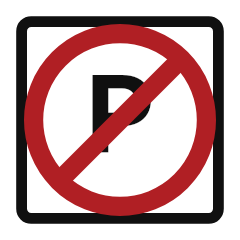
24. A driver leaves the vehicle at the curb where this sign is posted and walks away for two minutes. Is that allowed?
Show answer
Answer B: No, leaving the vehicle unattended there is prohibited whatever the length of the absence
Walking away leaves the vehicle parked, and the prohibition holds regardless of how long the driver is gone or whether the engine is left running.
-
25. You are behind a snow plow working on a highway. What is the correct way to drive?
Show answer
Answer C: Stay well back and do not try to pass it
A plow throws snow, runs wider than its body and works on the poor surface ahead of it, so the cleared road behind it is the safest place to be.
-
26. Automated red light camera enforcement in Illinois is authorized only in counties that meet certain criteria. Which of these is one of the counties where it is authorized?
Show answer
Answer C: Cook
Illinois authorizes automated red light enforcement only in Cook, Lake, Kane, DuPage, McHenry, Will, Madison, and St. Clair counties.
-
27. A piece of farm machinery ahead of you is wider than its own lane. What should you do?
Show answer
Answer C: Hold back until you can see far enough to pass safely
Wide equipment leaves no gap inside the lane and may use part of the other side, so a pass needs a long clear view of the road ahead.
-
28. You notice that the driver ahead of you is holding a phone to the ear. What should you do?
Show answer
Answer C: Assume slower reactions and leave extra space, or else hold back
A driver on the phone reacts late and misses things, so the safe response is distance rather than a lesson.
-
29. Loose items slide around your car and rattle every time you brake. What is the answer?
Show answer
Answer C: Secure them before you start driving
Sliding objects pull your attention and can roll under the pedals, so stow them in the trunk or wedge them before the trip rather than chasing them during it.
-
30. Your vehicle does not have antilock brakes and you must stop quickly on a slippery road. What is the correct technique?
Show answer
Answer B: Apply the brakes firmly without locking the wheels, releasing slightly if they lock
Locked wheels slide and cannot steer. Squeezing the brakes to just short of lockup, and easing off if they lock, gives the shortest stop with control.
-
31. How long may a new Illinois resident continue driving on a valid out-of-state driver's license before obtaining an Illinois license?
Show answer
Answer D: 90 days
Illinois allows a new resident to drive on a valid out-of-state license for 90 days before they must obtain an Illinois driver's license.
-
32. How does Illinois classify a speeding conviction for 35 miles per hour or more over the posted limit?
Show answer
Answer D: A Class A misdemeanor requiring a mandatory court appearance
Illinois classifies speeding 35 mph or more over the limit as a Class A misdemeanor, requiring a mandatory court appearance.
-
33. How should your following distance change in heavy rain?
Show answer
Answer D: It should be increased well beyond what you use on dry pavement
Wet pavement lengthens stopping distance and rain cuts visibility at the same time, so a larger gap gives you the extra seconds needed to see a problem and stop for it.
-
34. A pedestrian steps off the curb in the middle of a block where there is no crosswalk at all. What is the legal position?
Show answer
Answer A: They must yield to you, but you must still avoid a crash
A pedestrian crossing away from a crosswalk yields to vehicles, yet every driver still has a duty to use care and avoid hitting a person.
-
35. You have passed a large truck and want to move back into its lane. What should you see first?
Show answer
Answer B: Both of its headlights in your rear-view mirror
Seeing both headlights in your mirror means you are far enough ahead to be out of the truck's front no-zone before you move over.