
Illinois SOS Motorcycle Practice Test 20
- Questions25
- Correct to pass20
- Passing score80%
- Minimum age16 years
-
1. Which formation lets a group of riders stay close together while every rider keeps an adequate space cushion?
Show answer
Answer A: A staggered formation
A staggered formation keeps the group compact enough for traffic while still leaving each rider room to the front, the rear and both sides.
-
2. What happens to a motorcycle's ground clearance when a passenger is carried?
Show answer
Answer A: It is reduced, so parts touch down at a smaller lean angle
The extra load compresses the suspension and lowers the machine, so footrests and other parts can drag on the road sooner in a turn.
-
3. Where in the United States may a motorcycle ride between lanes of traffic?
Show answer
Answer C: Only where a state has specifically authorized it
Riding between lanes is prohibited in most states and permitted only where a state law expressly allows it, so a rider must know the rule for the state being ridden in.
-
4. Traffic is backed up just past the exit you want to use at a single-lane roundabout. What should you do?
Show answer
Answer D: Wait at the yield line until you can pass through and exit
You must not enter a roundabout unless you can clear it, because stopping inside blocks every other entry.
-
5. Which helmet style gives the rider the most coverage?
Show answer
Answer C: A full face helmet
A full face helmet covers the chin and jaw as well as the skull, protecting the area that open styles leave exposed.
-
6. A car is passing you on a two lane road. Which lane position is generally best while it goes by?
Show answer
Answer A: The center portion of your lane
The middle of the lane keeps distance from the passing vehicle and its mirrors while leaving room on the other side if the rider needs it.
-
7. Which feature suggests that a helmet is an uncertified novelty helmet?
Show answer
Answer D: A shell less than one inch thick with no firm foam liner
Novelty helmets are typically thin and very light because they lack the stiff energy absorbing liner that a certified helmet uses to manage an impact.
-
8. A downpour has just started on a street with a visible dark strip down the middle of the lane. Where should you ride?
Show answer
Answer A: In the left or right portion of the lane, away from the greasy center strip
Dripped oil and grease build up in the center of the lane, and water floats that film to the top, so the tire tracks on either side offer better grip.
-
9. Why should a rider pull in the clutch at the first sign that the engine is seizing?
Show answer
Answer B: So a locking engine cannot lock the rear wheel through the drive train
A seizing engine can lock up, and with the clutch engaged that would lock the rear wheel, so disconnecting the drive keeps the wheel rolling while you coast off the road.
-
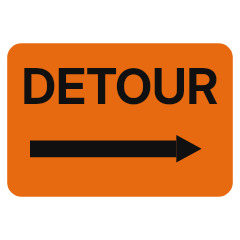
10. Once a driver has joined the route this sign begins, how is the rest of the way marked?
Show answer
Answer B: By further markers of the same kind at each turn, until the original road is rejoined
The alternate route is signed continuously, with a marker at every turn, so a driver with no local knowledge can follow it back to the original road.
-
11. Why does a motorcycle with a manual fuel supply valve have an OFF position?
Show answer
Answer A: It stops fuel reaching the engine while the machine is parked
Shutting the valve keeps fuel from seeping past the carburetor into the engine or onto the ground while the motorcycle stands unused.
-
12. Where should the rider be looking during a U-turn?
Show answer
Answer B: All the way around toward the point where the turn will finish
A motorcycle follows the eyes, so turning the head to the exit of the turn keeps the machine coming round instead of drifting wide.
-
13. What should you do with the key and your belongings when you leave the vehicle in a public lot?
Show answer
Answer D: Take the key with you, lock up and put valuables out of sight
Most vehicle thefts are opportunistic: a key left behind or a bag in plain view is the invitation.
-
14. Under Illinois law, can a driver with a BAC between .05 and .08 be convicted of DUI?
Show answer
Answer C: Yes, if other evidence shows their driving ability was impaired
Illinois law allows a DUI conviction for a BAC between .05 and .08 when additional evidence establishes that the driver's ability to drive safely was impaired.
-
15. At roughly what speed can hydroplaning begin when a lot of water is lying on the road?
Show answer
Answer C: At speeds as low as about 35 mph
With enough water and less than perfect tread, a tire can start to ride on the water at around 35 mph, well below normal highway speeds.
-
16. Which single event causes the largest share of crashes between a motorcycle and another vehicle at intersections?
Show answer
Answer B: A vehicle turning left across the path of an oncoming motorcycle
The classic motorcycle intersection crash is an oncoming driver who turns left across the rider's path, usually after failing to see the motorcycle or misjudging its speed.
-
17. What should riders expect from highway traffic when a group is merging?
Show answer
Answer C: Drivers will not hold a gap open for the group, so riders take real gaps
Other drivers do not treat a line of motorcycles as one vehicle, so each rider has to find a genuine gap rather than count on being let in.
-
18. Where is ice most likely to form first on a cold day?
Show answer
Answer B: In shaded areas and on bridges and overpasses
Shaded spots stay cold longer and bridges and overpasses lose heat from below as well as above, so ice appears there before it appears elsewhere.
-
19. A rider uses only the rear brake for a quick stop. What is the result?
Show answer
Answer B: A much longer stop, and a rear wheel that locks easily
With weight thrown forward the rear tire has little grip left, so it gives up only a small share of the available braking and skids under heavy pressure.
-
20. The leader gives a hand signal that you can see clearly from your place in the group. What should you do with it?
Show answer
Answer A: Repeat the signal so the riders behind you also receive it
Signals are passed down the line rider by rider, because riders further back cannot see the leader through the machines in between.
-
21. You have a green light at a school crossing, but the crossing guard steps out and holds up a stop sign toward you. What must you do?
Show answer
Answer A: Stop, because the crossing guard controls this crossing and outranks the signal
Directions from a crossing guard or a police officer take priority over signals and signs.
-
22. A sign reads END SCHOOL ZONE. What does it tell a driver?
Show answer
Answer A: The regular limit for that road applies again
An end of restriction sign marks the downstream limit of a special zone, after which the ordinary speed limit for that road governs again.
-
23. The vehicle you want to pass is traveling close to the speed limit. What should you do?
Show answer
Answer C: Stay behind, because a pass may not take you over the limit
The speed limit applies while passing too. If you cannot complete the pass without exceeding it, do not start the pass.
-
24. You have just returned to your own lane after passing. Why should you not slow down straight away?
Show answer
Answer A: The vehicle you passed is close behind and needs room to stop
Returning and then braking leaves the driver you just overtook with almost no following distance, which is how a pass turns into a rear-end collision.
-
25. Where is the oil and grease strip in a lane usually widest and most slippery?
Show answer
Answer D: At toll plazas, bus stops and intersections where vehicles sit and idle
Oil and coolant drip most where vehicles stop, idle and pull away, so the center strip is widest and slickest at toll booths, bus stops and busy intersections.