
Illinois SOS Motorcycle Practice Test 37
- Questions25
- Correct to pass20
- Passing score80%
- Minimum age16 years
-
1. Railroad tracks cross the road at a slight angle. What is normally the safest way to cross them?
Show answer
Answer B: Ride straight across while staying inside your own lane
Riding straight ahead within your lane is usually safe on tracks that cross the road, because swerving to square them up can carry you into another lane or into oncoming traffic.
-
2. It is hot and a rider wants to ride without gloves. Why is that a poor idea?
Show answer
Answer D: Sweating hands slip on the grips, and bare skin has no protection
Hands go out first in a fall and are hard to repair, and sweaty palms lose their grip on the controls, so wear ventilated summer gloves rather than none.
-
3. You are riding on a multi-lane road with a car traveling beside you in the lane on your right. Which lane position is usually best?
Show answer
Answer D: The left portion, so you keep a cushion of space from the car alongside
Lane position is chosen to hold space between the motorcycle and the nearest hazard, and here that hazard is the vehicle on the right.
-
4. How should the mirrors be set before setting off?
Show answer
Answer B: So that each mirror shows the lane behind and part of the lane beside
Mirrors aimed too far inward show mostly the rider, wasting the view that is meant to cover the traffic behind and to the side.
-
5. You come up behind a group of cyclists riding two abreast on a narrow rural road. What should you do?
Show answer
Answer A: Wait for a clear stretch and pass them as one group
Passing a group as a single unit when the way ahead is clear is safer than several rushed passes, and cutting through the group leaves nobody any escape room.
-
6. Which of these does NOT affect how fast alcohol reaches the bloodstream?
Show answer
Answer A: How confident the drinker feels
Food, the strength of the drinks and the speed of drinking all change how fast alcohol is absorbed, but a drinker's confidence changes nothing at all.
-
7. You are driving through patchy fog on a highway. What should you be ready for?
Show answer
Answer B: Sudden dense banks where visibility drops within a few car lengths
Patchy fog can go from clear to nearly blind in a moment, so keep your speed low enough that a sudden bank does not leave you without room.
-
8. Why do experienced riders cover the clutch lever and the brake lever in heavy traffic?
Show answer
Answer B: It shortens the time needed to react if they suddenly have to stop
With fingers already resting on the levers the rider skips the time it takes to reach for them, which shortens overall stopping distance.
-
9. You find that the road surface has turned to sheet ice. What speed is appropriate?
Show answer
Answer A: A crawl, slow enough that you could stop without braking hard
Ice can cut grip to a fraction of normal, so stopping takes many times the usual distance and only a crawl leaves any margin.
-
10. In most states, when are headlights required apart from times of poor visibility?
Show answer
Answer A: From about half an hour after sunset to half an hour before sunrise
Most states require lights from about half an hour after sunset until about half an hour before sunrise, and some simply say sunset to sunrise; lights are also required whenever visibility is poor.
-
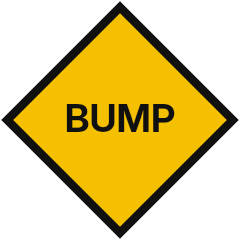
11. How should a driver respond to this sign?
Show answer
Answer C: Slow down before reaching the rough spot and cross it at a steady, low speed
Losing speed before a sharp rise in the pavement keeps the vehicle settled, while braking or accelerating on top of it unsettles the suspension and costs grip.
-
12. A traffic signal ahead is showing a flashing red light. What does it require?
Show answer
Answer C: Stop completely, then go when the way is clear, as at a stop sign
A flashing red light has the same meaning as a stop sign: stop completely, yield to traffic and pedestrians, then proceed when it is safe.
-
13. What criminal charges can result from causing a death while violating Illinois' Scott's Law in a highway work zone?
Show answer
Answer B: Involuntary manslaughter and reckless homicide, carrying 3 to 14 years of imprisonment if convicted
The Illinois Department of Transportation warns that a fatality caused while violating the Move Over law in a work zone can lead to charges of involuntary manslaughter and reckless homicide, carrying 3 to 14 years of imprisonment if convicted.
-
14. At night you are waiting to turn left and can see only the headlights of an approaching vehicle. Why should you allow a bigger margin?
Show answer
Answer D: Because lights alone make speed and distance hard to judge
With no other visual cues, two points of light give you very little information about how fast the vehicle is closing, so leave extra margin.
-
15. A delivery truck is parked in your lane and you must use the oncoming lane to get around it. Who has the right of way?
Show answer
Answer D: The oncoming traffic, because their lane is clear
The driver whose own lane is obstructed waits, because using the other lane is a favor from oncoming traffic, not a right.
-
16. Which statement about standard drinks is correct?
Show answer
Answer C: A standard serving of beer, of table wine and of distilled spirits each contain about the same amount of pure alcohol
Roughly 12 ounces of regular beer, 5 ounces of table wine and 1.5 ounces of 80 proof spirits each contain about the same amount of pure alcohol, so the type of drink does not change the effect.
-
17. Which action makes a wobble worse instead of better?
Show answer
Answer A: Braking or accelerating to try to ride out of it
Braking or adding power during a wobble can amplify it. Close the throttle gradually, hold the bars firmly and let the speed fall until the machine settles.
-
18. A ball rolls into the street from between parked cars ahead of you. What should you expect and do?
Show answer
Answer A: Expect a child to follow it and be ready to stop
A ball is usually followed by a child who is watching the ball and not the traffic. Slow down and be prepared to stop immediately.
-
19. The traffic around you is moving well above the limit on a wide highway. What should you do?
Show answer
Answer D: Keep to the limit and stay to the right, letting faster traffic pass
The limit is a legal maximum, and the safe way to differ from the traffic around you is to keep right and let it go by.
-
20. Your passenger has ridden on other people's motorcycles before. What should you do before setting off?
Show answer
Answer A: Brief them anyway, because your machine and your instructions differ
Handholds, footrests, exhaust position and the signals a rider uses all vary from machine to machine, so every passenger is briefed on the machine they are about to ride on.
-
21. An oncoming driver flashes their headlights while you are waiting to turn left. What should you do?
Show answer
Answer D: Judge the situation yourself, since the flash may mean something else
A flash is not a legal signal and may mean many things, so the decision to turn stays yours and must be based on what you can see.
-
22. Two solid white lines separate your lane from the lane beside it. What do they mean?
Show answer
Answer B: Crossing from one lane to the other is prohibited
A solid double white line marks a boundary that road users may not cross, such as the entrance to a preferential lane.
-
23. A vehicle coming toward you has drifted into your lane. What should you do?
Show answer
Answer D: Slow down, sound the horn, flash your lights and steer to the right if possible
Moving right gives the other driver space to recover and keeps you out of the lane they are most likely to return to. Braking reduces the force of any impact.
-
24. After a crash, what information should you exchange with the other driver?
Show answer
Answer B: Name, address, driver license, vehicle registration and insurance details
Identification, registration and insurance information are what the other party and the insurers need. Sensitive financial details are never required.
-
25. On an undivided two-lane road you meet a school bus coming toward you with its red lights flashing and its stop arm out. What must you do?
Show answer
Answer C: Stop and wait until the red lights stop flashing
On an undivided road drivers in both directions must stop for a school bus loading or unloading, because children may cross in front of it.