
Illinois SOS Motorcycle Practice Test 44
- Questions25
- Correct to pass20
- Passing score80%
- Minimum age16 years
-
1. A driver hunting for an on-ramp meets this sign at the mouth of the pavement ahead. What is the correct action?

Show answer
Answer C: Keep out of that roadway and look for the proper approach elsewhere
The restriction is absolute and does not depend on how much traffic is present, so the driver has to reach the highway by an approach built for entering vehicles.
-
2. A notification appears on your smart watch while you are driving. What should you do?
Show answer
Answer B: Treat it as you would a phone and leave it
A watch screen demands the same eyes and the same attention as a phone, and a wrist is no safer a place to read a message than a dashboard.
-
3. How does braking distance change if you double your speed?
Show answer
Answer D: It grows much more than twice as long
Braking distance increases with the square of speed, so doubling speed roughly quadruples the distance needed to stop.
-
4. The drive chain breaks or comes off while you are riding. What should you do first?
Show answer
Answer A: Close the throttle and brake to a stop clear of the roadway
A broken chain or belt takes the drive away at once, so the rider closes the throttle, slows under control with both brakes and stops well off the roadway.
-
5. A center lane is bordered by a solid yellow line on the outside and a broken yellow line on the inside, with turn arrows painted inside it. What is that lane for?
Show answer
Answer C: Left turns made by traffic traveling in either direction
That marking pattern identifies a two-way left-turn lane, which drivers approaching from both directions may use to prepare for a left turn.
-
6. What happens when alcohol is combined with another drug that also affects the nervous system?
Show answer
Answer B: Impairment is often far greater than either one alone would produce
Combined substances can multiply each other's effects, producing impairment well beyond what a driver would expect from either one taken separately.
-
7. A driver's blood alcohol concentration is below the legal limit, but the driver is visibly impaired. Can the driver be arrested?
Show answer
Answer C: Yes, driving while impaired by alcohol is an offense at any concentration
The per se figure, 0.08 percent in most states and 0.05 percent in Utah, is the level at which impairment is presumed. Impairment shown by driving behavior and field tests is enough on its own, because alcohol affects skills well before that number.
-
8. You turn from asphalt onto a loose gravel road. What should you do about your speed?
Show answer
Answer D: Lower it, since grip is reduced and stopping takes longer
Loose gravel gives far less grip than pavement, so speed must come down for both steering and stopping.
-
9. A yellow pennant-shaped sign is posted on the left side of a two-lane road facing you. What is it telling you?
Show answer
Answer B: You are entering a no-passing zone and may not start a pass
The pennant is placed on the left so that it faces the driver who might pull out, and it marks the beginning of a no-passing zone.
-
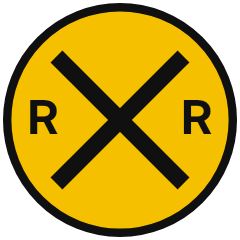
10. Where is this sign installed in relation to the hazard it announces?
Show answer
Answer A: Far enough before the hazard that a driver can slow down and stop short of it
This is an advance warning sign, placed on the approach so a driver has time to react before reaching a crossing that a curve or a crest may be hiding.
-
11. You are first in the queue at a red light with a marked crosswalk. Where should your vehicle stop?
Show answer
Answer A: Behind the stop line, so that the crosswalk stays clear
Stopping short of the line keeps the crosswalk usable for people on foot and keeps your vehicle out of the path of turning traffic.
-
12. A diamond-shaped sign is used to
Show answer
Answer A: warn of a condition on or next to the road that may call for caution
The diamond is the standard shape of the warning series, which alerts drivers to conditions that would otherwise not be obvious in time to react.
-
13. A flashing red lamp is mounted above a stop sign at a rural intersection. What does it add?
Show answer
Answer C: Emphasis, while the required stop stays the same
A stop beacon makes an easily missed stop sign more visible, but it neither adds to nor takes away from the obligation the sign already imposes.
-
14. From which lane should a permitted U-turn be started?
Show answer
Answer A: The lane nearest the center line, the same one used for a left turn
A U-turn is begun from the far left lane for your direction, the same position used for a left turn, so you do not cut across traffic beside you.
-
15. What should a rider understand about the horn on a motorcycle?
Show answer
Answer A: It is often weak and may not be heard, so it never replaces an escape route
A small horn competes with a closed car, a radio and traffic noise, so a rider plans a way out instead of trusting the horn to be heard.
-
16. How should a group plan its rest stops on a long day?
Show answer
Answer A: Around the rider who tires first, with breaks before anyone is worn out
Fatigue destroys judgment long before a rider admits to it, so the break schedule follows the least rested rider rather than the strongest one.
-
17. Traffic is heavy and you find yourself riding level with a car in the next lane. What is the problem with staying there?
Show answer
Answer B: You sit in the driver's blind spot, so a lane change could hit you
Motorcycles disappear easily in a blind spot, so adjust your speed to ride ahead of or behind the other vehicle instead of beside it.
-
18. The rider behind you is closing right up on your machine and crowding you. What is the best response?
Show answer
Answer D: Let them go past and take a position behind them instead
Speeding up to escape a rider who is following too closely usually brings them with you, while letting them past removes the pressure entirely.
-
19. Why should riding boots come above the ankle?
Show answer
Answer C: The ankle is easily broken and is left bare by a low shoe
The ankle takes a lot of damage when a motorcycle goes down or a foot is trapped, and a low shoe leaves it completely unprotected.
-
20. Under Illinois' Sign and Drive law, drivers no longer have to surrender their license as surety for most traffic tickets. For which offenses is license surrender still required?
Show answer
Answer C: DUI, reckless driving, and drag racing
Illinois' Sign and Drive law ended the practice of surrendering a license for most tickets, but DUI, reckless driving, and drag racing still require license surrender.
-
21. Once the motorcycle is leaned over and settled in a curve, what should the throttle be doing?
Show answer
Answer C: Held steady or rolled on gently through the curve
A steady or slightly increasing throttle keeps the suspension settled and the weight balanced, while closing it mid-curve unloads the rear tire.
-
22. What makes up the total distance needed to bring a vehicle to a stop?
Show answer
Answer A: The distance covered while you perceive the hazard, the distance covered while you react, and the braking distance
Total stopping distance combines the ground covered while you notice the hazard, the ground covered while you move your foot to the brake, and the ground covered while the brakes slow the vehicle.
-
23. You want to turn left at an intersection with no signs or signals and a vehicle is coming straight toward you from the opposite direction. What must you do?
Show answer
Answer C: Yield and turn after the oncoming vehicle has passed
A driver turning left always gives way to oncoming traffic that is close enough to be a hazard, whether or not the intersection is controlled.
-
24. You are turning right where a paved trail crosses the road just past the corner. What should you look for?
Show answer
Answer B: Cyclists and walkers arriving from either direction on the trail
A shared use path carries two-way traffic on foot and on bicycles, so scan both directions along the trail before crossing it.
-
25. You are stopped in a line of traffic waiting at a red light. What is the safest way to wait?
Show answer
Answer A: Stay in first gear, keep watching the mirrors and leave a way out
A vehicle approaching from behind may not stop in time, and staying in gear with a gap ahead lets the rider move out of the way.