
Illinois SOS Motorcycle Practice Test 46
- Questions25
- Correct to pass20
- Passing score80%
- Minimum age16 years
-
1. Why is smooth, early braking better than hard, late braking?
Show answer
Answer D: It keeps you in control and gives the driver behind more warning
Braking early and gently keeps the tires well within their grip and gives following drivers time to react to your brake lights.
-
2. What is the correct swerving technique?
Show answer
Answer D: Press the handgrip on the side you want to go and look toward the escape route
A swerve is two quick countersteering inputs, and because the motorcycle goes where the rider looks, the eyes belong on the open space.
-
3. How should a load be distributed between the two saddlebags?
Show answer
Answer B: Evenly, so the weight is balanced from side to side
An uneven load pulls the motorcycle toward the heavy side and makes it behave differently in left turns than in right turns.
-
4. A freeway sign shows a minimum speed limit. What does it require?
Show answer
Answer B: That you keep up with it unless conditions make that unsafe
A minimum speed limit keeps very slow vehicles off the highway, but weather, traffic or a mechanical problem may make a lower speed necessary and lawful.
-
5. What is true about driving away from a crash you were involved in?
Show answer
Answer B: It is a serious offense, even if the other driver has driven away too
Leaving the scene is a criminal offense in every state, and the behavior of the other driver does not excuse it.
-
6. In a staggered group, where does the leader normally ride?
Show answer
Answer B: In the left portion of the lane
The leader takes the left portion of the lane, which gives a wide view of the road ahead and sets up the staggered pattern for everyone behind.
-
7. A clutch cable adjusted with no free play at all causes what problem?
Show answer
Answer B: The clutch may slip and never fully engage
Without a small amount of slack the release mechanism keeps a light load on the plates, so they slip instead of transmitting full power.
-
8. You are stopped at an intersection where bushes block your view of cross traffic. What should you do?
Show answer
Answer A: Edge forward slowly until you can see, then proceed when clear
Creeping forward a little at a time lets you gain a view without committing to the crossing. Never enter an intersection you cannot see into.
-
9. Your lane is ending ahead in slow, heavy traffic and drivers in the next lane are already bumper to bumper. What is the recommended way to merge?
Show answer
Answer C: Take turns, one vehicle from each lane at the merge point
Alternating one for one at the merge point keeps both lanes moving and is the safest way to combine slow traffic.
-
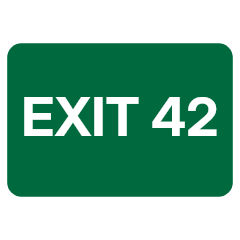
10. A driver in the left lane of a freeway realizes only when level with this sign that the ramp beside it is the one they need. What is the correct action?
Show answer
Answer A: Carry on to the next interchange and turn back from there
There is no safe way back to a ramp once it has been reached from the wrong lane, so the driver keeps going to the next interchange, where the ramps are built for that movement.
-
11. You find yourself in a lane that must turn, you wanted to go straight, and you cannot change lanes safely. What should you do?
Show answer
Answer D: Make the required turn and find another route
Going straight from a mandatory turn lane surprises everyone around you, while a wrong turn costs only a few extra minutes.
-
12. An obstacle appears ahead and you can see there is no room left to stop before it. What should you do?
Show answer
Answer D: Swerve around it
Once the distance is too short to stop, changing direction is the only option left, and a motorcycle can change direction faster than it can stop.
-
13. Where is a U-turn most clearly unsafe and generally prohibited?
Show answer
Answer D: On a curve or near a hill crest, where other drivers cannot see you
U-turns are barred where approaching drivers cannot see you in time, such as on a curve or near the top of a hill.
-
14. What identifies a helmet as certified to the federal motorcycle helmet standard?
Show answer
Answer C: A label showing DOT and the words FMVSS No. 218 CERTIFIED
Certified helmets carry a label with the DOT symbol and the wording FMVSS No. 218 CERTIFIED, together with the maker's name and the model.
-
15. A yellow curve warning sign carries a yellow plaque showing a speed. What does that number mean?
Show answer
Answer D: The recommended maximum safe speed for the curve under ideal conditions
An advisory speed plaque on a yellow warning sign gives the recommended maximum speed for the hazard ahead when conditions are good.
-
16. Visibility drops suddenly and you decide to leave the highway. What is the safest way to do it?
Show answer
Answer A: Take the next exit or a wide pull off, well clear of the traffic lanes
Get right off the traveled way, and off the shoulder too if you can, because vehicles in poor visibility often drift onto the shoulder.
-
17. A strong wind is blowing steadily across the road from your left. How should you ride?
Show answer
Answer A: Move toward the left of the lane and lean into the wind
Riding on the windward side of the lane leaves room to be pushed without leaving the lane, and a slight lean into the wind holds the line.
-
18. You are on a city street with two lanes in your direction, cars parked along the curb and driveways every few yards. Which lane is usually safer?
Show answer
Answer B: The lane farther from the curb, away from opening doors and vehicles pulling out
Most of the hazards on such a street come from the curb side, so the inside lane gives you more space and more time to react.
-
19. A yield sign is posted where an entrance ramp meets the highway. What must you do?
Show answer
Answer C: Give way to the traffic already on the highway and merge into a gap
The yield sign confirms that the merging driver is the one who must fit into the traffic stream rather than the other way round.
-
20. What is the main risk of buying a second hand helmet?
Show answer
Answer B: You cannot know whether it has been dropped or crashed already
A helmet's protection depends on a liner that may already be crushed by an impact you cannot see, and a stranger's helmet comes with no history you can trust.
-
21. In normal operation, which indication always comes between a green and a red on the same signal face?
Show answer
Answer C: A steady yellow
The yellow change interval must follow every green or green arrow, so a signal can never jump straight from green to red.
-
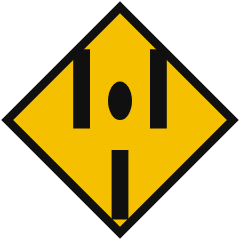
22. What must a driver be ready for beyond this sign?
Show answer
Answer C: Vehicles approaching from the opposite direction in the next lane over
The separation between the two directions runs out, so from that point oncoming vehicles share the same pavement and the driver has to keep right.
-
23. A large truck passes and hits you with a blast of wind. Which lane position leaves you the most room for error?
Show answer
Answer A: The center portion of the lane
A rider in the center portion of the lane has space on both sides to absorb the push of a wind blast without being shoved out of the lane.
-
24. Some toll facilities use signs and markings with a purple background or a purple stripe. What do they identify?
Show answer
Answer D: Lanes reserved for vehicles with an electronic toll account
Purple is assigned to lanes and ramps restricted to vehicles with a registered electronic toll collection account, so drivers without one must stay out.
-
25. Why are ordinary denim jeans a poor choice for riding?
Show answer
Answer C: They wear through in a slide, giving little abrasion protection
Light denim abrades away in a fraction of a second on pavement, while leather or purpose made textile gear stays intact long enough to protect the skin underneath.