
Illinois SOS Motorcycle Practice Test 34
- Questions25
- Correct to pass20
- Passing score80%
- Minimum age16 years
-
1. A streetcar is coming along tracks in the middle of the street as you wait to turn across them. What should you do?
Show answer
Answer A: Let the streetcar pass before you cross the tracks
Rail vehicles cannot steer around you and need a long distance to stop, so drivers yield to a streetcar or light rail train.
-
2. You are about to accelerate hard to merge with traffic. What should you have arranged with your passenger?
Show answer
Answer D: That you warn them beforehand so they can tighten their grip
A passenger who is not expecting a burst of acceleration is thrown backward, and the sudden shift of weight upsets the machine just when the rider needs it settled.
-
3. How do worn tires and worn brakes affect your ability to stop?
Show answer
Answer C: They lengthen the stopping distance, especially on a wet road
Worn tread cannot clear water and worn brakes cannot produce full force, so both stretch the distance needed to stop.
-
4. A vehicle in the lane beside you has stopped at a crosswalk. What should you do?
Show answer
Answer C: Stop as well, because that driver may be yielding to a pedestrian you cannot see
The stopped vehicle hides the crosswalk from you, and passing it is a leading cause of collisions with pedestrians who are already crossing.
-
5. Which federal standard must a motorcycle helmet meet to be sold for on-road use in the United States?
Show answer
Answer B: FMVSS No. 218
Federal Motor Vehicle Safety Standard No. 218 sets the impact, penetration and retention requirements for motorcycle helmets sold in the United States.
-
6. At an intersection the signal flashes red toward you and flashes yellow toward the cross street. Who must yield?
Show answer
Answer D: You must, because the flashing red faces your road
A flashing red means stop and yield like a stop sign, while a flashing yellow lets the other road proceed with caution.
-
7. You will leave your vehicle for several hours after dark. Where is the best place to park it?
Show answer
Answer D: In a well-lit spot with people and cameras nearby
Light, passing people and cameras all discourage theft and make your own return to the vehicle safer.
-
8. Why are motorcycles so often missed by other drivers?
Show answer
Answer C: Their narrow shape is easily hidden in traffic
A motorcycle presents a narrow outline that disappears behind pillars, mirrors and other vehicles, and it is harder to judge its speed and distance.
-
9. How much clear road do driver manuals say you need before starting a pass at highway speed on a two-lane road?
Show answer
Answer C: Enough to complete the pass and return, roughly ten to twelve seconds of travel
At highway speed the whole maneuver of pulling out, overtaking and returning takes roughly ten to twelve seconds, and every foot of that has to be visible before you start.
-
10. Where should the least experienced riders be placed in a group?
Show answer
Answer C: Just behind the leader
Placing newer riders just behind the leader keeps the pace manageable for them and lets the more experienced riders behind keep an eye on them.
-
11. What is the correct technique for a maximum effort stop in a straight line?
Show answer
Answer A: Squeeze the front lever progressively and press the rear pedal, staying upright
Both brakes together give the shortest stop, the front is squeezed progressively as weight transfers forward, and the machine must be upright with the bars square.
-
12. You are following a large truck on a two-lane road and cannot see past it. What should you do before deciding to pass?
Show answer
Answer D: Drop back so that your view of the road ahead opens up
Distance is what buys you a view around a large vehicle, and no decision to pass can be made from a position where you cannot see.
-
13. What does this sign tell a driver about the road ahead?
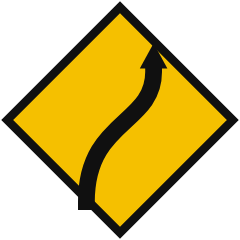
Show answer
Answer A: The roadway changes direction ahead, so speed should be reduced before reaching it
It gives advance notice of a change in alignment so the driver can slow down before entering, since braking inside a bend uses up grip that is needed for steering.
-
14. Fog thickens until you can barely make out the vehicle ahead. What is the safest action?
Show answer
Answer A: Slow right down and, if needed, leave the road at a safe place
In heavy fog the only safe speed may be very low, and if it drops below what the road allows, the answer is to pull well clear of the traffic lanes.
-
15. At an intersection where turning right on red is permitted and no sign prohibits it, what must you do before turning?
Show answer
Answer A: Come to a complete stop and yield to pedestrians and cross traffic
A right turn on red is allowed only after a full stop, and the turning driver must yield to pedestrians in the crosswalk and to traffic already using the intersection.
-
16. Why is the center portion of the lane a useful default on an open road?
Show answer
Answer B: It keeps a space cushion on both sides and discourages lane sharing
From the middle of the lane the rider has room to move either way, and no driver sees an obvious gap alongside to squeeze into.
-
17. May you exceed the posted speed limit in order to complete a pass?
Show answer
Answer C: No, the posted limit applies while you are passing too
The limit does not lift for passing; if you cannot complete the pass within it, there is not enough room and you should stay back.
-
18. What is the first riding effect of becoming dehydrated on a hot day?
Show answer
Answer D: Concentration and judgment fade before the rider feels very thirsty
Thirst lags behind fluid loss, so a rider can lose concentration and coordination before feeling thirsty. Drink regularly on hot rides rather than waiting.
-
19. A single solid white line separates two lanes running in the same direction. What is it telling drivers?
Show answer
Answer A: Changing lanes there is discouraged
A solid white lane line discourages lane changing, typically where merging or weaving would create a hazard.
-
20. What is the danger of riding in cold weather with thin gloves?
Show answer
Answer C: Cold, numb hands respond slowly and lose their feel for the controls
Wind chill at riding speed cools the hands quickly, and numb fingers are slower and less precise on the clutch, throttle and brake.
-
21. Four vehicles reach a four-way stop from all four directions at the same instant. How is the deadlock resolved?
Show answer
Answer C: Each driver yields to the vehicle on the right and they go one by one
Yielding to the right applies to every driver, so the group untangles itself as drivers take turns rather than moving together.
-
22. What happens when tires are driven underinflated for a long time?
Show answer
Answer D: They wear at the edges, they run hot and they are more likely to fail
An underinflated tire flexes too much, which wears the shoulders and builds up heat that can destroy the tire.
-
23. The circular sign shape is reserved for which warning?
Show answer
Answer C: Advance warning of a highway-rail grade crossing
A round yellow sign with a black X and the letters RR is the grade crossing advance warning sign, and the circular outline is used for no other message.
-
24. You face a red light at an intersection that has no stop line and no marked crosswalk. Where must you stop?
Show answer
Answer C: Before entering the intersection
With no line and no crosswalk, the stopping point is the near edge of the intersecting roadway, close enough to see cross traffic but clear of it.
-
25. The vehicle in front of you has stopped and is waiting to turn left, and there is a paved shoulder to the right. May you use it to get by?
Show answer
Answer D: No, in most states a pass may not be made by leaving the paved travel lanes
Passing on the right is normally lawful only inside the marked travel lanes, and most states prohibit driving onto the shoulder to get around a turning vehicle; the few states that allow it attach strict conditions.