
Illinois SOS Motorcycle Practice Test 35
- Questions25
- Correct to pass20
- Passing score80%
- Minimum age16 years
-
1. How should a rider dress for a long ride in very hot weather?
Show answer
Answer C: In ventilated riding gear that still covers the arms and legs
Mesh and vented riding gear flows air while keeping its abrasion protection and shading the skin, so heat is not a reason to ride uncovered.
-
2. You are stopped facing uphill on a steep grade and need to pull away. What is the recommended technique?
Show answer
Answer D: Hold with the rear brake, ease the clutch into the friction zone, then release
The rear brake keeps the motorcycle from rolling backward while the clutch takes up the drive, and it is released as the throttle is opened.
-
3. A driver ahead of you extends the left arm straight out horizontally through the window. What is being signaled?
Show answer
Answer C: A left turn
The left arm held straight out is the standard hand signal for a left turn.
-
4. You have begun to move into the next lane when the gap you were aiming for closes. What is the safest action?
Show answer
Answer C: Return to your own lane, cancel the signal and wait for a better gap
An unfinished lane change leaves you in a space that no longer exists, and the lane you came from is still yours.
-
5. A driver extends the left arm out the window and points it downward toward the road surface. What is being signaled?
Show answer
Answer A: Slowing down or stopping
The left arm extended downward is the standard hand signal for slowing or stopping.
-
6. Your low beams light about 250 feet of road, but at your speed you would need more than that to stop. What is that called?
Show answer
Answer D: Overdriving your headlights
When your stopping distance is longer than the stretch of road your headlights show, you cannot react to anything you finally see. Slow down until you can.
-
7. The lane you are in has a right-turn-only arrow painted on the pavement. What must you do?
Show answer
Answer C: Turn right, because a lane-use arrow is a legal requirement
Lane-use arrows painted on the pavement are regulatory markings, so a driver in that lane must travel in the direction shown.
-
8. How should tire pressure be checked and set?
Show answer
Answer B: When the tires are cold, set to the pressure specified by the vehicle manufacturer
Driving heats the air and raises the reading, and the sidewall number is a maximum rather than a recommendation, so check cold and use the figure on the vehicle placard or in the owner's manual.
-
9. Where should the weight of a load sit in relation to the rear axle?
Show answer
Answer A: Over the rear axle or in front of it
Weight placed behind the rear axle acts as a lever against the steering and can make the motorcycle wobble and handle and brake poorly.
-
10. Two lanes at the corner are marked for right turns. What does that require of you?
Show answer
Answer A: Keep your own lane through the turn and into the matching new lane
Dual turn lanes work only if each vehicle stays in its own lane all the way round and finishes in the corresponding lane of the new street.
-
11. Used correctly, roughly how much of a motorcycle's total stopping power comes from the front brake?
Show answer
Answer B: About three quarters of it
Braking shifts weight onto the front wheel, so a smoothly squeezed front brake supplies roughly 70 percent or more of the stopping power.
-
12. Does wearing properly fitted earplugs stop a rider from hearing important sounds?
Show answer
Answer C: No, they lower overall noise while horns and speech still register
Earplugs reduce the wind roar that masks everything else, so riders wearing them often hear traffic more clearly, not less, while their hearing is protected.
-
13. An emergency vehicle is stopped on the shoulder ahead with its lights flashing. What does the move over principle require?
Show answer
Answer D: Change lanes away from it, or slow down if you cannot
Move over laws ask you to give responders an empty lane, and where traffic or a two-lane road makes that impossible, you slow down instead.
-
14. Why should two riders never travel side by side in the same lane?
Show answer
Answer B: Because neither rider has room to swerve if a hazard appears
Riding directly alongside another motorcycle removes the escape path each rider needs to avoid a hazard, a pothole or another vehicle.
-
15. You are joining a highway from a short ramp that has no acceleration lane. What should you do?
Show answer
Answer A: Stop or slow at the end of the ramp and wait for a safe gap
Without an acceleration lane there is no room to match speed, so you must yield at the end of the ramp and enter only when a gap allows it.
-
16. You are calling 911 to report a crash. Which information matters most?
Show answer
Answer C: The exact location, how many people are hurt and any hazard such as fire
Dispatchers need to know where to send help, how much help to send, and what dangers the crews will meet on arrival.
-
17. You are approaching a yield sign and no other vehicle is anywhere in sight. What does the sign require?
Show answer
Answer A: Slow down and be ready to stop, but stop only if needed
A yield sign requires you to slow and give way, and to stop only when traffic or pedestrians make stopping necessary.
-
18. What restrictions apply to an Illinois motorcycle instruction permit?
Show answer
Answer B: Daylight riding only, under the direct supervision of a licensed motorcycle operator at least 21 years old with at least one year of experience
An Illinois motorcycle instruction permit allows riding only during daylight hours and only under the direct supervision of a licensed motorcycle operator who is at least 21 and has at least one year of driving experience.
-
19. You need to reverse direction on a busy street. Which choice is usually safest?
Show answer
Answer D: Driving around the block and using the intersections instead
Going around the block uses normal turns at controlled intersections instead of stopping across live traffic lanes.
-
20. Besides school signing, which warning signs may also use a fluorescent yellow-green background?
Show answer
Answer C: Pedestrian and bicycle warning signs
Pedestrian crossing, bicycle and playground warning signs may use either the standard yellow or the fluorescent yellow-green background, which draws extra attention where people outside vehicles are present.
-
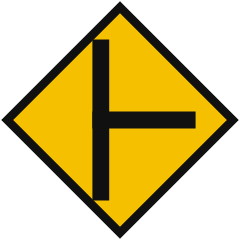
21. What condition does this sign warn a driver about?
Show answer
Answer B: Another road joins the road being traveled, from one side
It announces a side road entering the main roadway, so the driver should expect vehicles waiting to pull out and other vehicles slowing to turn in.
-
22. You are turning onto a street that has two lanes going your way. Which lane should you enter?
Show answer
Answer B: The lane closest to you, changing lanes later if you need to
Turn into the nearest lane going your direction and make any lane change afterwards, when you have signaled and checked that it is clear.
-
23. You have dropped some distance behind the rest of your group. What should you do?
Show answer
Answer C: Keep your own safe pace, because the group should slow to bring you back
Chasing the group means riding beyond a comfortable pace, so the responsibility sits with the leader to slow down until the formation is whole again.
-
24. Two drivers each have three drinks, one over three hours and one in half an hour. What is the difference?
Show answer
Answer C: The fast drinker reaches a higher peak level
The liver removes alcohol at a steady rate, so drinking faster than the body can clear it pushes the blood alcohol level much higher.
-
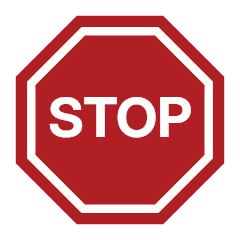
25. At an intersection where every approach carries this sign, two drivers arrive at exactly the same instant. Which of them goes first?
Show answer
Answer C: The driver on the right
Order of arrival decides who goes first, and when two vehicles arrive together the driver on the right proceeds while the other gives way.