
Illinois SOS Motorcycle Practice Test 49
- Questions25
- Correct to pass20
- Passing score80%
- Minimum age16 years
-
1. Once the Secretary of State issues a Monitoring Device Driving Permit to a first-time DUI offender, how long does the offender have to install a BAIID in every vehicle they intend to drive?
Show answer
Answer C: 14 days
An Illinois offender issued a Monitoring Device Driving Permit has 14 days to install a Breath Alcohol Ignition Interlock Device in every vehicle they plan to drive during the suspension.
-
2. How much following distance should you keep behind a motorcycle?
Show answer
Answer C: At least three to four seconds
A motorcycle can slow or stop very quickly and is easily upset by a surprise, so allow three to four seconds instead of the usual car gap.
-
3. When should a rider use both brakes together?
Show answer
Answer D: Every time the motorcycle slows or stops
Using both brakes for every stop shortens stopping distance and builds the habit the rider will fall back on when a sudden stop is needed.
-
4. What is a marked loading zone for?
Show answer
Answer A: Loading and unloading only, not for general parking
A loading zone is reserved for actively loading or unloading goods or passengers; leaving a vehicle there for other reasons is a parking violation.
-
5. You reach a one-lane bridge and a vehicle is already partway across it coming toward you. What should you do?
Show answer
Answer D: Stop before the bridge and let it come through
A vehicle already on a one-lane bridge has the right of way, and the driver who has not yet entered waits at the approach.
-
6. Which clothing offers the best protection for a rider?
Show answer
Answer D: Leather or sturdy synthetic gear covering the arms and legs completely
Leather and purpose built synthetics resist abrasion far better than ordinary clothing, and full coverage also guards against sun, wind chill and flying debris.
-
7. What does a blood alcohol concentration of 0.08 mean for the driver of a car?
Show answer
Answer B: It is the level almost every state treats as legally intoxicated
In almost every state a driver at 0.08 or above is legally intoxicated whatever the driver seems like, but impairment starts well before that level is reached.
-
8. What do the letters in the SEE riding strategy stand for?
Show answer
Answer B: Search, Evaluate, Execute
Riders search for hazards, evaluate how those hazards could interact, and execute a plan by adjusting speed, position or communication.
-
9. You are parking on a one-way street where parking is allowed on both sides. What must still be true?
Show answer
Answer D: The vehicle must face the direction the traffic flows
Either curb may be used on a one-way street where signs allow it, but the vehicle must always be headed in the direction traffic moves.
-
10. When is a driver or rider most likely to need hand and arm signals instead of the vehicle turn signal lamps?
Show answer
Answer D: When the lamps have failed or cannot be seen because of glare or a load
Hand and arm signals replace or reinforce the lamps whenever the lamps do not work or cannot be seen clearly by other road users.
-
11. What should the clutch be doing during a quick stop?
Show answer
Answer C: Pulled in as the motorcycle slows, so the engine does not stall
Disengaging the clutch as the machine slows keeps the engine running, so the rider can pull away again immediately if that becomes necessary.
-
12. Which road feature is most likely to be slippery, particularly when wet?
Show answer
Answer D: Painted lane markings, manhole covers and steel plates
Paint and metal surfaces laid on top of the road offer far less grip than the pavement around them and become noticeably slick in the rain.
-
13. When is a driver at the highest risk of falling asleep at the wheel?
Show answer
Answer B: Late at night, early morning and mid afternoon
The body clock produces its deepest dips in alertness in the small hours and again in the middle of the afternoon, and crash records follow those dips.
-
14. What is the job of the hard outer shell of a motorcycle helmet?
Show answer
Answer D: To spread impact force and to resist objects punching through
The shell distributes a concentrated blow over a wide area and stops sharp objects from reaching the head, while the liner underneath absorbs the energy.
-
15. In which situation should you increase your usual following distance?
Show answer
Answer B: On wet roads, at night, in fog, when towing a trailer, or when following a motorcycle
Reduced traction, reduced visibility, a heavier load and a vehicle that can stop faster than yours all require extra space to keep the same margin of safety.
-
16. A large panel mounted on a trailer at the roadside displays a flashing arrow pointing left. What does it tell you?
Show answer
Answer B: Move into the lane to your left
An arrow panel directs traffic out of a closed lane, so the arrow shows the direction you must move rather than the shape of the road ahead.
-
17. The divided highway ends warning sign means that
Show answer
Answer D: the median separating the directions ends and the road returns to two-way operation
Beyond this sign opposing traffic is no longer separated by a median, so the driver must keep right and expect vehicles approaching in the adjacent lane.
-
18. Your group is turning left across oncoming traffic. What should you do?
Show answer
Answer D: Wait until you personally have a large enough gap to turn
Each rider needs a gap of their own, and turning on the strength of the rider ahead means turning into traffic you have not actually judged.
-
19. Upon a first DUI conviction in Illinois, as distinct from the pre-trial statutory summary suspension, what is the minimum period a driver loses full driving privileges?
Show answer
Answer C: One year
A first DUI conviction carries a minimum one-year revocation of driving privileges, separate from the statutory summary suspension that begins before trial.
-
20. Federal law lets a state open its high-occupancy vehicle lanes to certain vehicles carrying only one person. Which of these is covered by that allowance?
Show answer
Answer B: Motorcycles
Federal law lets states allow motorcycles into high-occupancy vehicle lanes regardless of the number of occupants, because keeping riders in the flow is safer than the alternative.
-
21. You are at a red light where right turns on red are allowed, you cannot see clearly, and the driver behind sounds the horn. What should you do?
Show answer
Answer C: Stay stopped until you can see that the turn is safe
Turning right on red is permitted, never required, so you wait until you can see that the way is clear no matter what the driver behind does.
-
22. Which of these is never a legal place to park?
Show answer
Answer C: In a crosswalk, on a sidewalk or within an intersection
Crosswalks, sidewalks and intersections must stay clear so that pedestrians can cross and drivers can see approaching traffic.
-
23. What must a motorcycle be equipped with before it can safely carry a passenger?
Show answer
Answer B: A seat large enough for two people and a set of passenger footrests
A passenger needs a seat with room for both people without crowding and firm footrests to brace against.
-
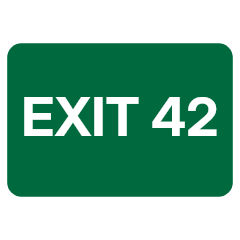
24. Where is signing of this kind normally placed along a freeway?
Show answer
Answer D: Ahead of the interchange and again at the exit, so a driver can reach the correct lane in time
Guide information for an interchange is repeated on the approach and at the ramp, because a driver who learns about the exit only at the last moment has no room left for a safe lane change.
-
25. A dog is running toward the road from a yard ahead of you. Why is it a mistake to simply accelerate past it?
Show answer
Answer A: A dog aims at where you will be, so more speed can bring you together
A dog runs at an intercept point rather than at where you are now, which is why the recommended technique is to slow as you approach and then accelerate away once you are beside it.