
Illinois SOS Motorcycle Practice Test 50
- Questions25
- Correct to pass20
- Passing score80%
- Minimum age16 years
-
1. What is the maximum fine a court may impose for a first DUI conviction in Illinois when the driver's BAC was below .16?
Show answer
Answer D: $2,500
A first DUI conviction in Illinois carries a maximum fine of $2,500, along with up to one year of imprisonment.
-
2. A hands free phone conversation is which kind of distraction?
Show answer
Answer C: Cognitive, because your mind leaves the road
Hands free equipment removes the manual and visual parts of a call but not the mental load, and it is the mental load that makes a driver miss hazards.
-
3. You are parked legally, but a police officer tells you to move the vehicle. What should you do?
Show answer
Answer B: Move it as directed, because an officer overrides the signs
Directions from a police officer or a firefighter take precedence over signs and markings, whether they are directing traffic or clearing a street.
-
4. The overhead signal above your lane changes to a steady yellow X. What should you do?
Show answer
Answer B: Prepare to move out of that lane
A steady yellow X warns that the lane is about to close, so drivers should get ready to vacate it in favor of an open lane.
-
5. How should braking and swerving be combined?
Show answer
Answer C: Brake before or after the swerve, never during it
Traction can be spent on turning or on braking, and asking for both at once during a swerve is very likely to cause a skid.
-
6. Which color scheme is standard for the drums and barricades that channel traffic through a work zone?
Show answer
Answer C: Alternating orange and white retroreflective stripes
Drums and barricades carry alternating orange and white retroreflective stripes, and the traffic cones used in the same zones are predominantly orange.
-
7. How may a two-way left-turn lane never be used?
Show answer
Answer B: As a through travel lane or a passing lane
The lane exists only for turning movements, so traveling or passing along it puts you head-on with vehicles turning from the opposite direction.
-
8. When should headlights be switched on besides during the hours of darkness?
Show answer
Answer C: Whenever rain, fog, snow or dust makes it harder to see or to be seen
Headlights are as much about being seen as about seeing, so they go on whenever visibility drops.
-
9. How does a rider open the throttle to increase speed?
Show answer
Answer C: By rolling the right handgrip toward the rider
Rolling the right handgrip toward you opens the throttle, and rolling it away closes it so the engine slows.
-
10. Which feature matters most in clothing meant to keep a rider warm?
Show answer
Answer C: A windproof outer layer, since moving air strips body heat fast
Wind blowing through clothing carries away heat faster than anything else, so a windproof outer shell over insulating layers is what keeps a rider warm.
-
11. You have just passed a large truck on the freeway. Why is it dangerous to pull back in front of it and then brake for your exit?
Show answer
Answer B: A loaded truck needs much more distance to stop than a car
A fully loaded tractor-trailer can need the length of a football field or more to stop from highway speed. Cutting in and braking leaves the driver no room to avoid hitting you.
-
12. The engine begins to lose power, makes a loud noise and starts to seize. What should the rider do?
Show answer
Answer C: Pull in the clutch at once and coast off the road to a safe place
A seizing engine can lock the rear wheel, and pulling in the clutch separates it from the wheel so the motorcycle keeps rolling under control.
-
13. What does it mean to scan the road while driving?
Show answer
Answer A: Moving your eyes constantly over the road, the sides and the mirrors
Scanning keeps information coming in from every direction, while a fixed stare leaves you blind to everything else.
-
14. A school sign paired with a plaque showing a diagonal downward-pointing arrow is installed
Show answer
Answer D: at the school crossing itself, or as close to it as possible
The diagonal downward arrow points at the crossing, so this assembly is placed at the crossing location rather than in advance of it.
-
15. How should a rider and passenger arrange to communicate during a ride?
Show answer
Answer A: By agreeing on simple signals or taps before the ride starts
Wind and engine noise make speech unreliable, so a short set of signals agreed in advance is the dependable way for a passenger to say they need to stop.
-
16. A pedestrian signal displays a steady walking person symbol. What does it mean for a pedestrian at that corner?
Show answer
Answer B: The pedestrian may start crossing in the direction of the signal
The steady walking person permits a pedestrian to begin the crossing, while still yielding to vehicles already lawfully in the intersection.
-
17. When does Illinois law specifically require headlights to be turned on besides at night?
Show answer
Answer C: Whenever the windshield wipers are in use
Illinois law requires drivers to use headlights whenever the windshield wipers are operating, and headlights should also be used when objects 1,000 feet away cannot be seen.
-
18. How should cargo be carried on a motorcycle?
Show answer
Answer D: Kept low, in saddlebags or at about seat level
Keeping the load low preserves the center of gravity and the normal handling of the motorcycle, while a high load makes it top heavy and unstable.
-
19. It is dusk and a jogger in dark clothing is running along the edge of the road. What should you do?
Show answer
Answer D: Slow down and scan the edges of the road
Dusk is the hardest light for spotting people, and dark clothing removes most of your warning, so lower speed and a careful scan of the roadsides are the answer.
-
20. In a work zone, the flagger's instructions conflict with the pavement markings still visible on the road. Which do you follow?
Show answer
Answer B: The flagger, because a person directing traffic outranks the markings
An authorized flagger controlling a temporary traffic control zone overrides signs, signals and markings, and drivers must obey the flagger's signals.
-
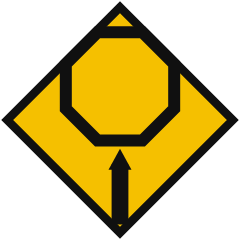
21. What is the driver expected to do after passing this sign?
Show answer
Answer A: Begin slowing so that a complete stop can be made at the intersection ahead
It is used where the control at the intersection stays hidden until late, so braking should begin here rather than at the stop line.
-
22. Which of the following is NOT required equipment for a motorcycle rider under Illinois law?
Show answer
Answer C: A helmet
Illinois does not require a helmet, although the state manual strongly recommends one; eye protection, mirrors and a horn are all required equipment.
-
23. Oil is visible running down the front fork tubes. What does that mean?
Show answer
Answer C: A fork seal has failed and the suspension needs repair
Fork oil escaping past a seal means the front suspension is losing its damping, and the oil can also reach the front brake and ruin its grip.
-
24. When should a passenger get on the motorcycle?
Show answer
Answer D: After the engine has been started and the operator is ready
Mounting after the engine is running and the operator is settled keeps the motorcycle stable and spares the operator a long balancing act with the extra weight aboard.
-
25. At a four-way stop you and an opposing driver arrive together. You are going straight and the other driver is turning left across your path. Who goes first?
Show answer
Answer B: You do, because the left turn crosses your path
When two opposing drivers arrive together, the one going straight goes first and the left-turning driver yields.