
Illinois SOS Motorcycle Practice Test 5
Test 5 of 6. Pick an answer for each question to see if it is right and why; your score appears at the end. You need 20 correct answers to pass, the same ratio as the real Illinois test.

- Questions25
- Correct to pass20
- Passing score80%
- Minimum age16 years
-
1. A farm implement ahead of you on a two-lane road is wider than its own lane. What should you do?
Show answer
Answer D: Hang back until you can see past it and pass only with a clear road
Wide equipment hides the road ahead and may extend farther across the center line than it appears, so the pass needs more room and a much better view.
-
2. A vehicle ahead of you displays a reflective orange triangle on its rear. What does that emblem tell you?
Show answer
Answer B: The vehicle is built to travel at 25 mph or less
The orange triangle is the slow moving vehicle emblem used on farm and construction equipment designed for 25 mph or less, warning you that you are closing on it much faster than it appears.
-
3. You are behind three slow vehicles on a two-lane road and the way ahead looks clear. What is the sound decision?
Show answer
Answer D: Pass one vehicle at a time, if the road allows it
Passing several vehicles in one move keeps you in the oncoming lane far too long and leaves nowhere to go if a vehicle appears.
-
4. What does the thick foam liner inside a certified helmet actually do in a crash?
Show answer
Answer C: It crushes so the head slows down over a longer time and distance
The crushable liner is the part that absorbs energy, letting the head decelerate gradually instead of stopping instantly against a hard surface.
-
5. You are driving through a residential area where parked cars hide the side streets. What is the safest approach?
Show answer
Answer C: Slow down and cover the brake as you pass each opening
Where parked vehicles hide side streets and driveways, lower speed and a covered brake buy the time you lose in sight distance.
-
6. A bicyclist stops at a four-way stop just before you do. Who goes first?
Show answer
Answer B: The bicyclist, who reached the intersection and stopped there before you did
A bicyclist on the roadway follows the same right of way rules as a driver, so arrival order decides the turn.
-
7. Why is it worth planning your route before a long drive?
Show answer
Answer B: So that you are not reading a map or a screen while the car is moving
A driver who knows the route is not navigating at the wheel, which is one of the commonest sources of distraction.
-
8. Unless otherwise posted, what is the Illinois speed limit in an alley?
Show answer
Answer D: 15 miles per hour
Illinois sets 15 miles per hour as the default speed limit in alleys unless a different limit is posted.
-
9. You are parking on a one-way street where parking is allowed on both sides. What must still be true?
Show answer
Answer D: The vehicle must face the direction the traffic flows
Either curb may be used on a one-way street where signs allow it, but the vehicle must always be headed in the direction traffic moves.
-
10. Can an Illinois driver be convicted of DUI with a blood alcohol concentration below .08?
Show answer
Answer C: Yes, if driving ability is impaired
Illinois makes it illegal to drive at .08 or more, but a driver whose ability is impaired can still be convicted of DUI at a lower reading.
-
11. The traffic around you is moving well above the limit on a wide highway. What should you do?
Show answer
Answer D: Keep to the limit and stay to the right, letting faster traffic pass
The limit is a legal maximum, and the safe way to differ from the traffic around you is to keep right and let it go by.
-
12. What eye protection does Illinois law require on a motorcycle?
Show answer
Answer D: Both the driver and any passenger must be protected by glasses, goggles or a transparent windshield
Illinois required equipment rules state that both driver and passenger must be protected by glasses, goggles or a transparent windshield.
-
13. What is the Illinois school zone speed limit and when does it apply?
Show answer
Answer C: 20 miles per hour on school days between 6:30 a.m. and 4 p.m. when children are present and signs are posted
Illinois school zones are posted at 20 miles per hour and the limit applies on school days between 6:30 a.m. and 4 p.m. when children are present and the signs are posted.
-
14. When should a rider add a layer on a ride that is turning cold?
Show answer
Answer D: Before you start to feel cold, at the next convenient stop
Once a rider is chilled it takes a long time to warm up again, and cold hands and slowed reactions cost control, so add layers before the cold takes hold.
-
15. What does Illinois law say about a motorcycle passing between two vehicles traveling in the same direction?
Show answer
Answer C: It is prohibited unless an unobstructed traffic lane is available to permit the pass safely
Illinois prohibits motorcycle riders from passing between two other vehicles going the same direction unless an unobstructed traffic lane is available, and passing on the right requires at least 8 feet of unobstructed pavement.
-
16. You pass into a work zone with a reduced speed limit but you see no workers. What speed applies?
Show answer
Answer D: The posted work zone limit, whether or not workers are present
A posted work zone speed limit is a regulatory limit in force at all times, and narrow lanes and uneven surfaces remain dangerous when nobody is working.
-
17. Another driver is behaving aggressively toward you. What should you do?
Show answer
Answer D: Avoid eye contact, give them room to go on their way and do not respond to provocation
Responding to an aggressive driver escalates the conflict, while creating distance and refusing to engage takes you out of the situation. Report serious threats once you can do so safely.
-
18. A driver is thinking about overtaking a slower vehicle and sees this sign a short distance ahead. What does it mean for that pass?
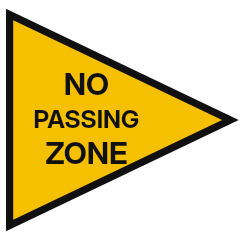
Show answer
Answer B: The pass must be finished before the restricted section begins
The sign marks the start of a section where passing is prohibited, so a driver may not be on the left side of the road beyond it; any pass has to be completed before that point or not started at all.
-
19. Under Illinois' basic speed law, besides curves and hill crests, in which other situations must a driver reduce speed even without a posted sign lowering the limit?
Show answer
Answer B: When approaching and crossing an intersection, or traveling on a narrow or winding roadway
Illinois' basic speed law also requires reduced speed when approaching and crossing an intersection and when traveling on a narrow or winding roadway.
-
20. Illinois' Scott's Law is named after a Chicago Fire Department lieutenant who was killed by an intoxicated driver in 2000 while responding to a crash on which expressway?
Show answer
Answer D: The Dan Ryan Expressway
Scott's Law is named for Lieutenant Scott Gillen of the Chicago Fire Department, who was killed by an intoxicated driver in 2000 while assisting at a crash on the Dan Ryan Expressway.
-
21. Your vehicle stalls on railroad tracks and you see a train approaching. What should you do?
Show answer
Answer D: Get everyone out and run toward the train at an angle away from the tracks
Leave the vehicle at once. Running toward the oncoming train and away from the tracks keeps you clear of the wreckage, which is thrown forward in the direction the train is moving.
-
22. Under Illinois' basic speed law, in which of these situations must a driver reduce speed below the posted limit even without a separate warning sign?
Show answer
Answer D: When approaching and going around a curve, or approaching a hill crest
Illinois' basic speed law requires drivers to reduce speed when approaching and going around a curve or approaching a hill crest, among other listed hazards.
-
23. Traffic safety experts describe three kinds of driver distraction. Which set is correct?
Show answer
Answer A: Visual, manual and cognitive
Distraction takes the eyes off the road, the hands off the controls or the mind off driving, and many activities do more than one of those at once.
-
24. A driver hunting for an on-ramp meets this sign at the mouth of the pavement ahead. What is the correct action?

Show answer
Answer C: Keep out of that roadway and look for the proper approach elsewhere
The restriction is absolute and does not depend on how much traffic is present, so the driver has to reach the highway by an approach built for entering vehicles.
-
25. Can a driver be charged with impaired driving after taking a legal over the counter medicine?
Show answer
Answer C: Yes, if the medicine impairs the ability to drive safely
Impaired driving laws cover any substance that affects driving, including cold remedies, allergy pills and sleep aids sold without a prescription.